
Key takeaways:
A decade can change a lot. Homeowners returning to the market may face different property prices, interest rates, lending conditions and buyer competition.
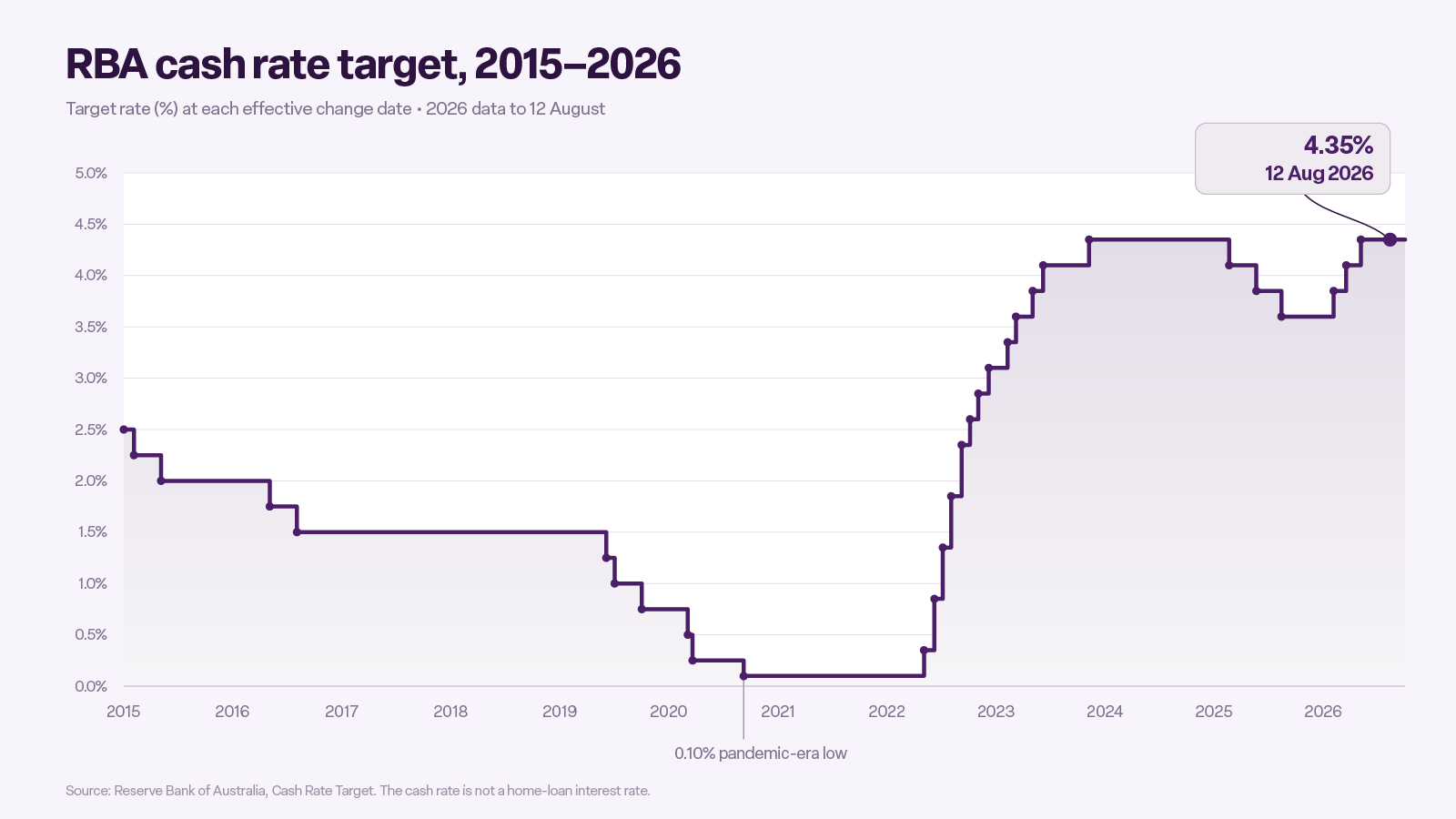
Interest rates have shifted significantly. The RBA cash rate fell from 2% in 2015 to a record-low 0.1% during COVID before rising above 4%.
Borrowing assessments are different. APRA's mortgage serviceability buffer is currently 3 percentage points, meaning lenders must assess borrowers at least 3 percentage points above their loan rate.
Higher income doesn't guarantee more borrowing power. Lenders also consider expenses, debts, dependants and serviceability requirements when assessing how much someone may be able to borrow.
Check your borrowing power before making offers. An Aussie Broker can help you understand where you stand today and compare loan options based on your circumstances.
For Justin Singh, buying a home in 2026 felt very different from the last time he went through the process.
He and his wife Anjana bought their first home in The Gap in Queensland in 2015 and stayed there for almost 11 years.
When they eventually returned to the market, their lives had changed considerably.
They had a young daughter, wanted more outdoor space and were looking for a home that better suited the next stage of family life.
But it wasn't just their circumstances that had changed.
The property market they returned to looked very different from the one they remembered.
“When we bought our first place back in 2015, we walked into the inspection, we were the only people there, and it was just a one-on-one conversation with the agent,” Justin said.
“This time around, we probably went through 15 to 20 open homes. At the first few inspections there were probably 15 or 20 groups going through each property.”
For homeowners who have been in the same property for close to a decade, that experience may feel familiar.
Cotality's Pain & Gain report found properties that resold for more than they originally paid in the March quarter of 2026 had typically been owned for 9.1 years.
That means many homeowners returning to the market today may not have actively bought property since before COVID. Since then, interest rates fell to record lows, property prices surged and the RBA subsequently embarked on a rapid rate-hiking cycle.
What changed between 2015 and 2026?
Justin's two buying experiences sit on either side of an extraordinary decade for Australian property.
When he first bought in 2015, the Reserve Bank had reduced the cash rate to 2%. Inflation was relatively subdued, interest rates were falling and borrowing conditions were supportive of housing demand.
Independent property economist Cameron Kusher said the broader economic backdrop was also different.
“Inflation was low, and certainly material cost inflation was quite low. Interest rates were low and falling, and that was quite favourable for both supply and demand in the housing market,” he said.
Then came COVID-19.
The pandemic initially brought significant economic uncertainty. Policymakers responded with an unprecedented level of support as buyers and sellers pulled back, unemployment increased and Australia entered its first recession in almost three decades.
The RBA progressively reduced the cash rate to a record-low 0.1% by November 2020, while government stimulus supported households, jobs and housing activity.
At the same time, COVID restrictions changed how Australians lived and spent. Household savings increased, while working from home and spending more time there made additional space and outdoor areas more important for some buyers.
Combined with record-low borrowing costs and government support, these conditions helped fuel housing demand as the economy reopened.
By 2021, Australia's housing market had moved rapidly from pandemic uncertainty to strong price growth.
ABS data shows residential property prices across the eight capital cities increased 23.7% in the year to December 2021, the strongest annual rise since the series began in 2003.
A decade of change at a glance
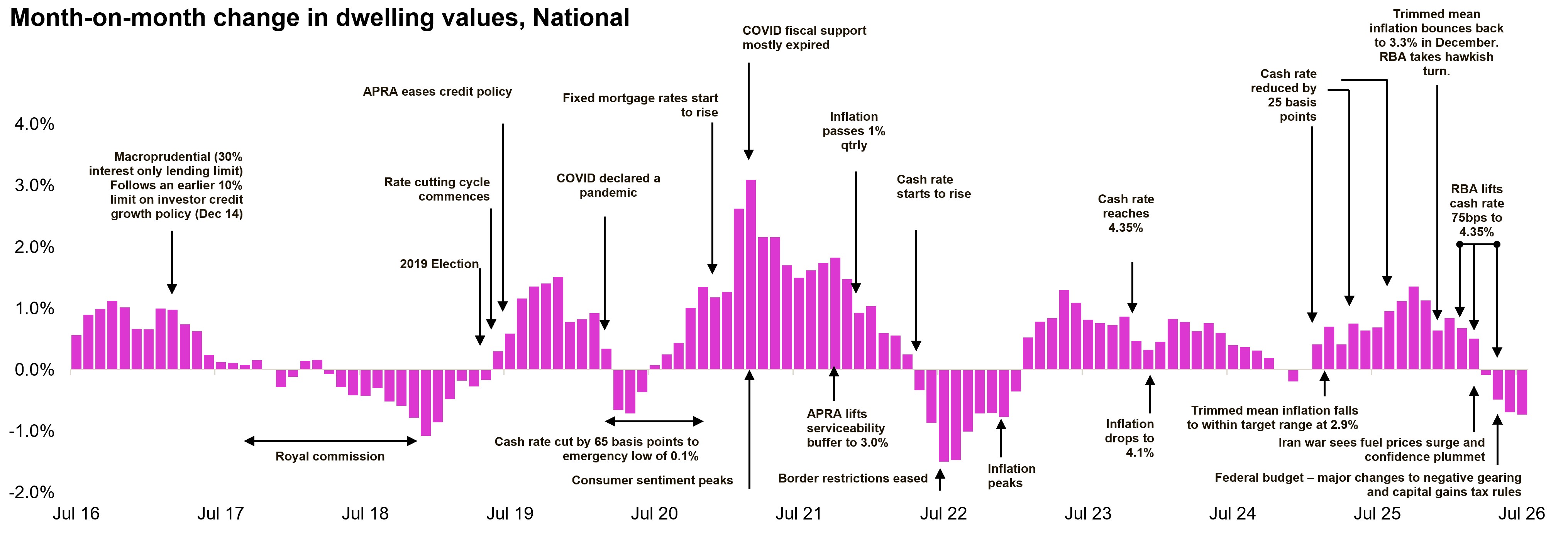
Cotality, month-on-month change in dwelling values, National
But the economic environment changed again.
As restrictions lifted, stronger spending combined with global supply-chain disruptions, higher energy and commodity prices and other cost pressures to push inflation higher.
The RBA began raising the cash rate in May 2022, stating inflation had increased more quickly and to a higher level than expected.
By November 2023, the cash rate had reached 4.35%. Rates eased during 2025 before increasing again in early 2026.
As of the time of publication, the cash rate remains at 4.35%.
For Australians returning to the property market after a decade, that history matters.
Someone who last bought in 2015 isn't simply returning to higher property prices. They may also be borrowing in an environment with different interest rates, household costs, and lending assessments.
That combination can change how far a household's income stretches, how much they may be able to borrow and the trade-offs they face when choosing their next home.
You might also be interested in: What will happen if interest rates increase in 2026?
A growing family can change what matters in a home
Justin and Anjana's first home still worked well in many ways. What had changed was what they wanted from it.
Outdoor space had become more important, as had living closer to friends with children around the same age as their daughter.
“For my wife, who's very outdoorsy, it just got to the point where we felt we needed something with a proper yard and a bit more space,” Justin said.
“We wanted to bring back that sense of community and have all the kids grow up together, like I did.”
Their experience reflects a common upgrader challenge.
You might also be interested in: Your step-by-step guide to upsizing to a bigger family home
The home someone bought years earlier may still be functional, but a growing family, changing work arrangements or different lifestyle priorities can shift what they need from their next property.
That can lead to a much bigger question than simply “can we afford to move?”
Buyers may also need to consider if they are willing to compromise on location, land size, property type, repayments or timing.
For buyers weighing up these trade-offs, an Aussie Buyer’s Agent can also help them understand how different suburbs and property types compare with their brief and budget.
Before Justin and Anjana began making offers, they spoke with Kara Doyle of Aussie Coolum to understand their borrowing position and established a clearer starting point for their search.
Kara said one of the biggest changes long-term homeowners may encounter when returning to the market is how much their budget buys.
“Price, definitely,” she said of what surprises people most.
“I guess it's really just that the market has changed so much.”
As the couple's search progressed, Kara worked with them to reassess their position and adapt their plans with the changing market.

The Singh Family. Photo: Supplied
“It was really about reassuring them and saying, ‘Let's reassess everything, see where things are at, and put a plan in place to achieve what you're hoping to achieve’,” she said.
The search eventually led the family to Upper Kedron, where they purchased a four-bedroom, three-bathroom home on a 700-square-metre block.
The property included many of the features they had been looking for, including more outdoor space and two separate living areas, while also putting them closer to friends.
Why borrowing power can feel different the second time around
One of the biggest differences for returning buyers is that borrowing capacity may not look the way they expect.
A decade of career progression or higher household income does not necessarily translate directly into a proportionately larger home loan.
Depending on the lender, an assessment may consider income alongside living expenses, debts, dependants and other financial commitments, as well as lending policies and serviceability requirements.
Households themselves may also look very different from when they first bought. Someone who purchased before having children, for example, may now have different household costs or other financial commitments.
Kara said the lending environment has also moved considerably over the past decade.
“It's changed a lot over 10 years,” she said.
“With the recent rate rises, that's impacted people's buying capacity too. It's a bit of a wave with the highs and the lows, and that's just interest rates, let alone changes to credit policy.”
Kusher added the combination of property prices and borrowing costs is central to today's affordability challenge.
“Borrowing costs are higher, the price you pay for a property is higher, and we haven't seen a lot of income growth over that same time as well," he said.
Importantly, borrowing capacity isn't necessarily static.
Interest rate movements, lender policies or changes in a household's circumstances can affect what may be achievable, even during the course of a property search.
“I don't think people realise the impact that interest rate rises have,” Kara said.
“All these little factors mean you could speak to a client six months ago, and their circumstances could be completely different today.”
For homeowners returning to the market, checking borrowing power early can provide a clearer idea of budget and give buyers time to consider whether they need to adjust their location, property expectations or timing.
For Justin and Anjana, understanding their borrowing position early gave them a starting point for their search. As the search progressed, Kara continued to reassess their position and work through questions as they arose.
“It's such an emotional journey,” she said.
“They didn't want to buy something just for the sake of it. They wanted to make sure they were buying the right home.”
The buying experience itself has changed
For Justin, the difference wasn't just financial.
The pace and tone of the property search felt different too.
At some inspections early in the year, he said multiple groups were competing for the same home. He also found real estate agents were more direct about buyer budgets.
“It was a very different and more intense experience this time around compared to when we bought our first home,” he said.
That can create pressure for buyers to make decisions quickly.
But a competitive inspection doesn't necessarily mean a buyer should stretch beyond what they're comfortable spending.
Knowing your borrowing limit and having a clear view of potential repayments before making offers can help provide a financial boundary when emotions and competition increase.
You might also be interested in: Using equity to buy a second home or investment property
Are buyers getting more room to negotiate?
Interestingly, Justin noticed conditions beginning to change towards the end of his search.
"Towards the end of our buying journey, in the last six weeks, things really quietened down. Instead of seeing 15 or more people at inspections, there’d only be three or four.”
Kusher also pointed to greater choice in some parts of the market.
“There's already quite a lot of stock on the market, so people who are willing to buy at the moment do have quite a lot of choice and not a lot of competition,” he said.
You might also be interested in: Why some buyers may have more room to negotiate in today’s property market
That doesn't mean every buyer has stronger negotiating power.
Conditions can vary considerably between cities, suburbs, price ranges and property types, while affordability remains challenging.
But where competition has eased, buyers who have their finances prepared may have more room to compare homes, negotiate or walk away when a property doesn't stack up.
An Aussie Buyer’s Agent can help assess comparable sales, understand local market conditions and negotiate with the selling agent on a buyer’s behalf, which may be useful for those returning to the market after several years.
Buying again? Start with today's numbers
For homeowners who last purchased years ago, previous experience can still be useful.
But the assumptions attached to that experience may no longer apply.
Before starting the search, returning buyers may want to consider:
What could you borrow today? Current income, expenses, debts, dependants and lender requirements can all affect borrowing capacity.
What repayments would you be comfortable with? The amount a lender may be prepared to lend and the amount a household feels comfortable repaying can be different.
What does your next home need to achieve? Separating must-haves from nice-to-haves may help when prices or borrowing limits require compromises.
How flexible are you? Location, property type, land size and timing may all become part of the decision.
Kara said the key is starting with the objective rather than the property.
“You need to get everything lined up first while you're still looking and planning,” she said.
"I always ask, 'What are your goals?' and then we work out how to achieve them.”
For Justin and Anjana, returning to the market after more than a decade meant adjusting to a very different buying environment.
“It was quite daunting because it had been over 10 years since our first purchase, and a lot had changed with the market and even dealing with banks,” Justin said.
“But working with an Aussie Broker was a really smooth process. Any questions we had, she was there the whole time. Anytime we needed to get in contact with her, she was very prompt and thorough with her responses.”
Having Kara there to reassess their position and work through questions as the search developed helped the couple navigate a buying environment they hadn't experienced before.
Their experience offers a practical lesson for other homeowners returning after a long absence: don't assume the property market or borrowing environment will look the way it did last time.
Starting with an up-to-date understanding of your finances, and having someone you can return to as circumstances change, may help make the next move easier to navigate.