
Key takeaways
The RBA increased the cash rate by 0.25 percentage points to 4.60% in September, marking the fourth rate rise in 2026.
The RBA said inflation remains elevated, with some of the upside risks it identified in August now materialising.
The next RBA meeting is 2–3 November, with inflation and broader economic conditions likely to remain important to the outlook.
Understanding different rate scenarios can help you prepare your home loan, borrowing power and property plans.
The Reserve Bank of Australia (RBA) increased the cash rate by 0.25 percentage points to 4.60% at its September 2026 meeting, marking the fourth increase this year.
In explaining the decision, the RBA said inflation remains elevated and that some of the upside risks identified in August are materialising.
These include higher global energy prices, rising global prices for some technology-related goods, and continued domestic cost pressures.
For homeowners, first home buyers and investors, the question now shifts to what could happen next and how the current interest rate environment could affect their home loan and property plans.
Where is the cash rate now?
The RBA increased the cash rate by 25 basis points in February, March, May and September 2026, with holds in June and August. The cash rate now sits at 4.60%.
RBA cash rate in 2026
Date | Decision | Cash Rate |
|---|---|---|
Feb 2026 | +0.25% | 3.85% |
Mar 2026 | +0.25% | 4.10% |
May 2026 | +0.25% | 4.35% |
Jun 2026 | Hold | 4.35% |
Aug 2026 | Hold | 4.35% |
Sep 2026 | +0.25% | 4.60% |
Source: Reserve Bank of Australia
A look at how RBA interest rates have moved over time
While rate increases have attracted significant attention, interest rates have moved through many cycles over the past several decades.
The RBA adjusts the cash rate in response to a range of factors, including inflation, employment, economic growth, and global conditions.
Looking at interest rates over a longer period can help provide context for current settings and highlight that monetary policy typically changes over time as economic conditions evolve.
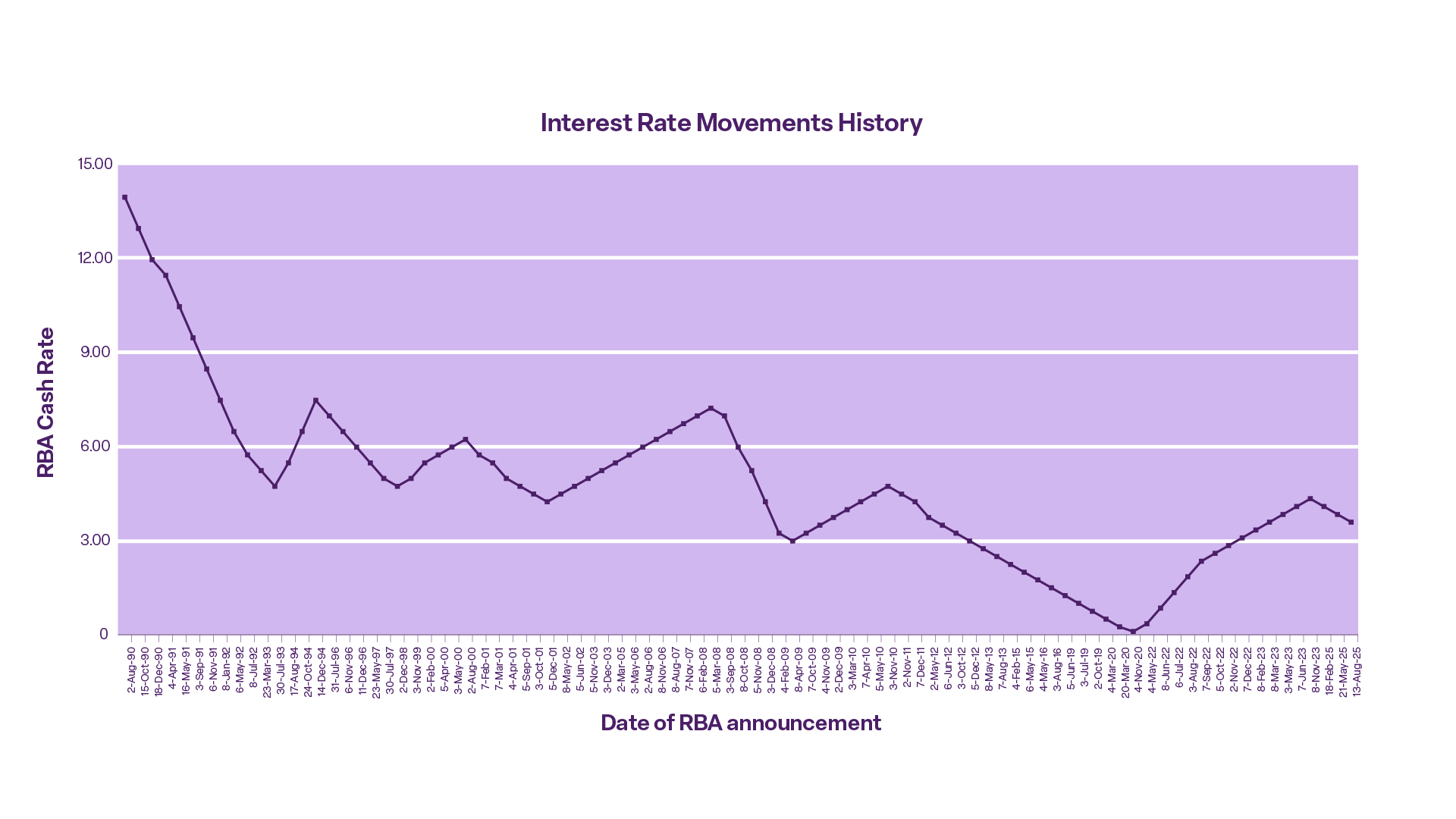
While today's interest rates are higher than the record lows seen during the pandemic, the cash rate has moved through many cycles over time as the RBA responds to changing economic conditions.
Why has the RBA raised rates?
The RBA uses the cash rate as one of its main tools for influencing inflation. Higher interest rates can reduce demand across the economy by increasing borrowing costs and encouraging saving.
At its September meeting, the RBA said inflation remained elevated and that some of the upside risks it identified in August were materialising.
The RBA pointed to several factors affecting the inflation outlook, including higher global energy prices following the broadening conflict in the Middle East, rapid growth in global prices for technology-related goods and continued domestic cost pressures.
It also said recent Australian inflation outcomes had been stronger than expected at its previous meeting.
At the same time, the RBA noted that output growth had slowed, although June-quarter growth was slightly stronger than expected, while consumer spending showed signs of easing gradually.
The September increase took the cash rate to 4.60%, with future decisions continuing to depend on how inflation and broader economic conditions evolve.
You might also be interested in: What to do if your mortgage repayments increase
Will interest rates rise again in 2026?
After the RBA's September increase, attention now turns to whether further tightening could be needed before the end of 2026.
There is no certainty around the next move. The RBA said future decisions will be guided by incoming data and its assessment of the risks, with inflation remaining an important part of the outlook.
Before the September decision, some major bank economists were already forecasting another increase later in the year. ANZ said it expected increases in both September and November, which would take the cash rate to 4.85%.
Not all economists expect a series of further increases, however.
Shane Oliver, AMP Chief Economist, said financial markets may have moved too far towards expecting multiple hikes.
“The markets have swung to this view that we’ll see multiple hikes from here, and I think that’s probably a bit too bleak.”
Oliver's base case before the September meeting was for the RBA to increase rates in September, followed by an extended period on hold before cuts potentially begin in the second half of 2027.
Forecasts can change as new economic data becomes available, so they shouldn't be treated as confirmed RBA decisions.
The RBA's next Monetary Policy Board meeting is scheduled for 2-3 November, followed by its final meeting of the year on 7-8 December.
Rather than relying on one particular forecast, borrowers may find it useful to consider how their finances could cope if rates stay around current levels, rise again or eventually begin to ease.
What to watch before the next RBA decision
The RBA's next Monetary Policy Board meeting is scheduled for 2–3 November. Before then, several economic indicators could help shape the outlook.
Inflation
The RBA has said inflation remains elevated, so upcoming CPI data will remain an important indicator of whether price pressures are easing or proving more persistent.
Household spending
The RBA said consumer spending appeared to be easing gradually at its September meeting. Future data could provide more information about how higher borrowing costs are flowing through household demand.
Economic growth
June-quarter GDP growth was slightly stronger than the RBA had expected, although output growth had slowed overall.
Global developments
The RBA has highlighted higher global energy prices and geopolitical developments as risks to the inflation outlook.
Source: Reserve Bank of Australia
The outlook isn't necessarily moving in one direction, however. Independent economist Nicki Hutley said the RBA is weighing a range of competing forces across the economy.
“There are a fair few things at play. It’s not all one-sided in this equation. There are forces that are also acting to help bring inflation down.”
That makes upcoming data particularly important, as the RBA assesses whether inflationary pressures remain persistent alongside signs of slower activity.
No single data point determines an RBA decision. The Board considers a range of economic information when assessing the outlook for inflation and the economy.
Possible rate paths and what they could mean
Scenario | What this could look like |
|---|---|
Rates remain around current levels | The RBA keeps the cash rate around 4.60% while monitoring inflation and broader economic conditions. |
Another increase | Inflationary pressures remain stronger or more persistent than expected, and the RBA decides further tightening is needed. |
Rates eventually begin to ease | Inflation moves sustainably towards the RBA's 2-3% target range, and economic conditions eventually allow the RBA to consider lowering the cash rate. |
Note: These scenarios are illustrative only.
The RBA has said future decisions will be guided by incoming data and its assessment of evolving risks.
Scenario planning: What should buyers, homeowners, and investors do?
Interest rates are only one part of the property decision-making process. While future RBA decisions remain uncertain, understanding how different scenarios could affect your plans may help you prepare.
Scenario 1: Rates stay around 4.60%
What happens?
The cash rate remains around its current level while the RBA continues to assess inflation and broader economic conditions.
Property markets may continue to vary by location, with buyers and sellers adjusting to higher borrowing costs.
What to consider
Review your budget, borrowing power, and loan structure. If you're planning to buy, refinance, or invest, understanding your options early may help you make more informed decisions.
Scenario 2: Rates rise again
What happens?
If inflationary pressures remain stronger or more persistent than expected, the RBA could consider further tightening.
A higher cash rate could increase borrowing costs if lenders pass some or all of the change through to home loan rates, which may affect household budgets and borrowing capacity.
What to consider
Review your budget and loan repayments and consider whether your current loan structure still suits your circumstances. If you're planning to buy or refinance, understanding your borrowing power may help you prepare for different interest rate scenarios.
Scenario 3: Rates stay higher for longer
What happens?
Inflation takes longer to return sustainably to target, leading the RBA to keep the cash rate around current levels for longer.
Borrowing costs remain elevated, and affordability remains a key focus for many households.
What to consider
Rather than trying to predict market movements, focus on affordability, cash flow, and your long-term financial goals. For some buyers and investors, understanding what is achievable today may be more valuable than waiting for conditions to change.
You might also be interested in: First-home buyer reality check – What’s changed in 12 months?
What role could the Federal Budget play?
The RBA sets monetary policy independently from government, but government spending, taxation and housing policies can still influence broader economic conditions.
The 2026–27 Federal Budget included housing and taxation reforms aimed at increasing housing supply and improving access to home ownership over time.
These include changes to:
Negative gearing arrangements for future property purchases
Capital gains tax concessions
Housing supply incentives
The reforms have now been legislated and will largely take effect from 1 July 2027.
They limit negative gearing for residential property investments to new builds and replace the 50% capital gains tax (CGT) discount for eligible taxpayers with cost base indexation and a 30% minimum tax on capital gains, subject to the legislated transitional arrangements.
The Australian Government has said the reforms are intended to encourage investment in new housing supply and support housing affordability over time.
The full market impact remains uncertain and is likely to vary between locations and property types.
What could current interest rates mean for homeowners?
Following four cash rate increases in 2026, some borrowers may be managing higher home loan repayments where lenders have passed on some or all of those increases.
If you've been focused on keeping up with recent rate changes, it may also be worth reviewing whether your current home loan still suits your needs.
Some homeowners are using this period to:
Compare their interest rate with current market offerings
Review loan features
Consider refinancing opportunities
Reassess household budgets
Even if you decide not to change lenders, understanding your options can provide greater confidence about your financial position.
You might also be interested in: What the headlines aren’t telling first-home buyers right now
What could current interest rates mean for refinancers?
Even when the cash rate is on hold, lenders may adjust their home loan rates independently.
For borrowers who haven't reviewed their loan recently, comparing their current rate, features and repayments with other available options may help them understand whether their loan still suits their circumstances.
Others may be exploring refinancing because:
Their fixed rate has expired
They want to access equity
Their financial circumstances have changed
They are looking to consolidate debt
Refinancing also comes with costs and may not be the right option for everyone.
Whether it makes sense will depend on factors such as your current interest rate, how long you plan to stay in the property, and whether the potential savings outweigh any fees involved.
An Aussie Broker can help you understand what options may be available based on your individual circumstances.
What could this mean for first-home buyers?
Higher interest rates can affect borrowing capacity because lenders assess whether borrowers can afford repayments at higher interest rates, including through serviceability assessments.
Following four cash rate increases in 2026, first home buyers may want to check their current borrowing capacity rather than rely on an estimate or pre-approval obtained before recent rate changes.
The impact will vary depending on income, expenses, existing debts, lender policies and individual circumstances.
Property market conditions can also vary significantly by location, so borrowing power is only one part of the affordability picture.
For first home buyers, preparation in the current environment may include:
Understanding your current borrowing power
Building a deposit and savings buffer
Exploring government schemes you may be eligible for
Considering what repayment level would be manageable
Obtaining conditional pre-approval before making an offer
Interest rates matter, but they're only one part of the home-buying equation.
Property prices, household budgets, savings, and borrowing capacity can all affect what may be achievable for an individual buyer.
You might also be interested in: What is serviceability buffer and how does it affect your home loan
What could this mean for investors?
Property investors are currently weighing a range of factors, including interest rates, borrowing capacity, property cash flow, and upcoming tax changes.
Alongside the higher cash rates, investors may also be assessing how the Federal Budget tax reforms could affect future investment decisions.
The legislated changes to negative gearing and capital gains tax arrangements will largely take effect from 1 July 2027.
However, investment decisions typically involve a range of factors, including:
Rental demand
Property cash flow
Borrowing capacity
Long-term capital growth potential
Tax considerations
Given the complexity of the proposed reforms, investors may wish to seek independent financial, legal and taxation advice.
What should Australians focus on now?
While the direction of the cash rate is outside borrowers' control, there are steps you can take to better understand your own position.
Rather than relying on a particular interest rate outcome, it may help to consider your budget, borrowing capacity and property goals under different rate scenarios.
Property prices, borrowing capacity and competition can all change over time, meaning the right time to buy, refinance or invest will depend on your individual circumstances rather than interest rates alone.
Practical steps may include:
Reviewing your home loan
Understanding your borrowing power
Building a savings buffer
Considering how future rate changes may affect your budget
Seeking guidance before making major property decisions
No one can know with certainty where interest rates will go next. Understanding your position today, and how different rate scenarios could affect your budget or borrowing power, may help you feel better prepared for future changes.
How Aussie can help
Whether you're buying your first home, reviewing your current loan, refinancing or investing, understanding your options is an important first step.
An Aussie Broker can help you:
Compare home loan options
Understand your borrowing power
Explore refinancing opportunities
Review your loan structure
Navigate changing market conditions
Aussie Brokers are here to help you understand your options and make informed decisions about your home loan.