Key takeaways:
Buying on a median income may still be possible. Your borrowing capacity depends on more than your income.
You may not need a 20% deposit. Low-deposit home loans and government support may help eligible buyers purchase sooner.
Where you buy affects what you can afford. Units and regional NSW homes generally require smaller deposits than Sydney dwellings.
Government support may improve affordability. Eligible buyers could benefit from the Australian Government 5% Deposit Scheme or Help to Buy.
Planning can help you buy sooner. A clear savings strategy and advice from an Aussie Broker can help you understand your options.
Can you buy a home on a median income in NSW or the ACT?
For many first-home buyers, the answer is yes, but it depends on factors such as your income, deposit, borrowing capacity and where you want to buy.
Buying a home is more challenging than it was a decade ago. Property prices and living costs have risen, making it harder to save a deposit. But a 20% deposit isn't always required.
Depending on your circumstances, low-deposit home loans and government support may help eligible buyers enter the market sooner.
In this guide, you'll learn:
How median incomes in NSW and the ACT compare with current property prices.
How long it could take to save a deposit for different property types and deposit sizes.
Whether you need a 20% deposit, or if a lower deposit could be an option.
How government support may assist eligible buyers.
Remember, there's no single income that guarantees you'll be able to buy a home. Lenders assess each application based on your income, expenses, existing debts, savings and borrowing capacity.
Note: This article contains general information only. It doesn't take into account your personal financial situation or needs, so consider whether it's right for you before making a decision. Talk to an Aussie Broker for advice specific to your circumstances.
At a glance: Median income vs average income
If you're trying to work out whether you can afford to buy a home, median income is a more useful benchmark than average income.
Measure | What is shows | Why it matters |
|---|---|---|
Median income | The midpoint of all incomes | Better reflects what a typical Australian earns and is a more practical benchmark for housing affordability. |
Average income | The mean of all incomes | Can be skewed by high-income earners, making it less representative of most home buyers. |
Average income (also known as the mean) is calculated by dividing total income by the number of income earners. Because a relatively small number of high-income earners can push the average up, it doesn't always reflect what a typical person earns.
Median income is the midpoint, meaning half of income earners earn more and half earn less. That's why it's widely used to measure housing affordability and compare incomes across different regions.
According to ABS Personal Income data (2022–23), the median total personal income was $58,909 in NSW and $75,643 in the ACT. By comparison, ABS average weekly ordinary time earnings for full-time adults were $2,051.10 in November 2025, or about $106,657 a year, illustrating how averages can overstate what many Australians earn.
That's why this guide uses median income to compare earnings with property prices and to explore what may be affordable for first-home buyers.
What does a median-priced home look like today?
What you can buy depends on both your budget and where you want to live. While Sydney and Canberra remain among Australia's most expensive housing markets, units generally offer a lower entry price than the broader dwelling market.
The figures below use Cotality's Home Value Index, which estimates median residential property values. Because values are updated monthly, they should be treated as a snapshot of the market.
Source: Cotality. (2026, July). Home Value Index: Index results as of 30 June 2026.
In Sydney, a median-priced dwelling may include an established house in a middle or outer-ring suburb, a townhouse or a larger apartment, depending on the location. Buyers considering units may find a lower entry point, with the median unit value sitting below $900,000.
In Canberra, the gap is even wider. The median unit value is around $288,000 lower than the median dwelling value, making units a more affordable option for many first-home buyers. If you're buying a unit, remember to factor in ongoing costs such as strata levies alongside the purchase price.
Median values are useful benchmarks, but they don't represent a typical home. Property size, age, condition and location can vary significantly, so comparing suburbs and property types will give you a more accurate picture of what's available within your budget.
How much deposit do you need?
A 20% deposit is often used as the benchmark because it may help you avoid paying lenders' mortgage insurance (LMI). However, it's not the only option. Depending on the lender and your circumstances, you may be able to buy with a smaller deposit.
Using the latest median property values, here's how much you'll need for different deposit sizes.
Property | 5% deposit | 10% deposit | 20% deposit |
|---|---|---|---|
Sydney median dwelling | $63,280 | $126,561 | $253,122 |
Canberra median dwelling | $44,263 | $88,525 | $177,051 |
Sydney median unit | $44,931 | $89,862 | $179,725 |
Canberra median unit | $29,872 | $59,743 | $119,486 |
The right deposit amount depends on your financial situation, the lender's requirements, and whether you're eligible for government support or other low-deposit home loan options.
You might also be interested in: How to save for a house deposit: Tips for first-time buyers
How long could it take to save a deposit on a median income?
How long it takes to save depends on your income, how much you can save each year and the type of property you're buying.
The examples below assume a single buyer saves 20% of their after-tax income each year, with no major changes to income, living costs or property prices. They're intended as a guide only.
Saving for a dwelling
Saving a 20% deposit for a median-priced dwelling can take many years, particularly in Sydney, where property prices are significantly higher than in Canberra.
That's one reason many first-home buyers choose to buy with a partner, purchase a unit or explore low-deposit home loans instead of waiting until they've saved 20%.
Saving for a unit
Because units typically cost less than detached homes, they generally require a smaller deposit and may be a more achievable first step into the property market. However, remember to budget for ongoing costs such as strata levies.
Your savings timeline can also change as your income grows, your living expenses change, or property prices move over time.
Do you really need a 20% deposit?
Not necessarily.
While a 20% deposit remains a common goal, many lenders offer home loans with smaller deposits. Eligible buyers may also be able to access government initiatives that reduce the upfront deposit needed to buy a home.
Buying with less than a 20% deposit may mean paying lenders mortgage insurance (LMI). LMI protects the lender if you default on your loan and can often be added to your loan balance, increasing the amount you borrow.
For some buyers, paying LMI may be worthwhile if it means buying sooner rather than spending more years saving a larger deposit.
You might also be interested in: How much do you need for a house deposit?
Low-deposit home loans
Depending on the lender, you may be able to buy with as little as a 5% deposit. Eligible buyers may also qualify for support through the Australian Government 5% Deposit Scheme or Help to Buy, subject to eligibility criteria, participating lenders, property price caps and lending requirements.
Government support for first-home buyers
Saving a deposit is one of the biggest challenges for many first-home buyers. To help eligible Australians enter the property market sooner, the Australian Government offers initiatives that can reduce either the upfront deposit or the amount you need to borrow.
Eligibility criteria, property price caps, participating lenders and lending requirements apply.
Want to learn more? Read our guide to first-home buyer grants and concessions to explore the government support that may be available in your state or territory.
Could buying in regional NSW help you enter the market sooner?
If you're flexible about where you buy, regional NSW could offer a more affordable path to homeownership. Lower property prices can reduce the deposit you'll need, the amount you borrow and your ongoing mortgage repayments.
According to the latest Home Value Index, the median dwelling value in regional NSW is $841,198, compared with $1,265,608 in Sydney.
Location | Median dwelling value |
|---|---|
Sydney | $1,265,608 |
Regional NSW | $841,198 |
A difference of more than $420,000 can significantly impact your upfront costs. For example, a 20% deposit on Sydney's median dwelling is $253,122, compared with $168,240 for a regional NSW median dwelling. That's a saving of almost $85,000.
Buying a lower-priced property may also reduce the deposit you'll need, lower the amount you borrow, improve your borrowing capacity and reduce your mortgage repayments.
Affordability is only one part of the decision.
Regional living may have trade-offs, including different employment opportunities, fewer public transport options or being further from family and friends. On the other hand, many regional centres offer larger homes, more land and growing local economies.
You might also be interested in: Moving to regional areas: Why more Australians are making the switch
Where should first-home buyers look in 2026?
Choosing where to buy involves more than comparing property prices. Transport links, employment opportunities, local infrastructure and your long-term lifestyle goals are all worth considering alongside affordability. Areas attracting first-home buyers include:
Western Sydney: Suburbs such as Penrith, Campbelltown and Mount Druitt offer lower entry prices than many inner-city locations while benefiting from ongoing infrastructure investment.
Canberra: Districts including Tuggeranong, Belconnen and Gungahlin provide a mix of houses, townhouses and apartments across a range of price points.
Central Coast: Areas around Wyong may appeal to buyers seeking more space while maintaining access to Sydney.
Regional NSW: Cities such as Orange, Dubbo and Wagga Wagga continue to attract buyers looking for lower property prices and established communities.
The right location depends on your budget, lifestyle and long-term goals.
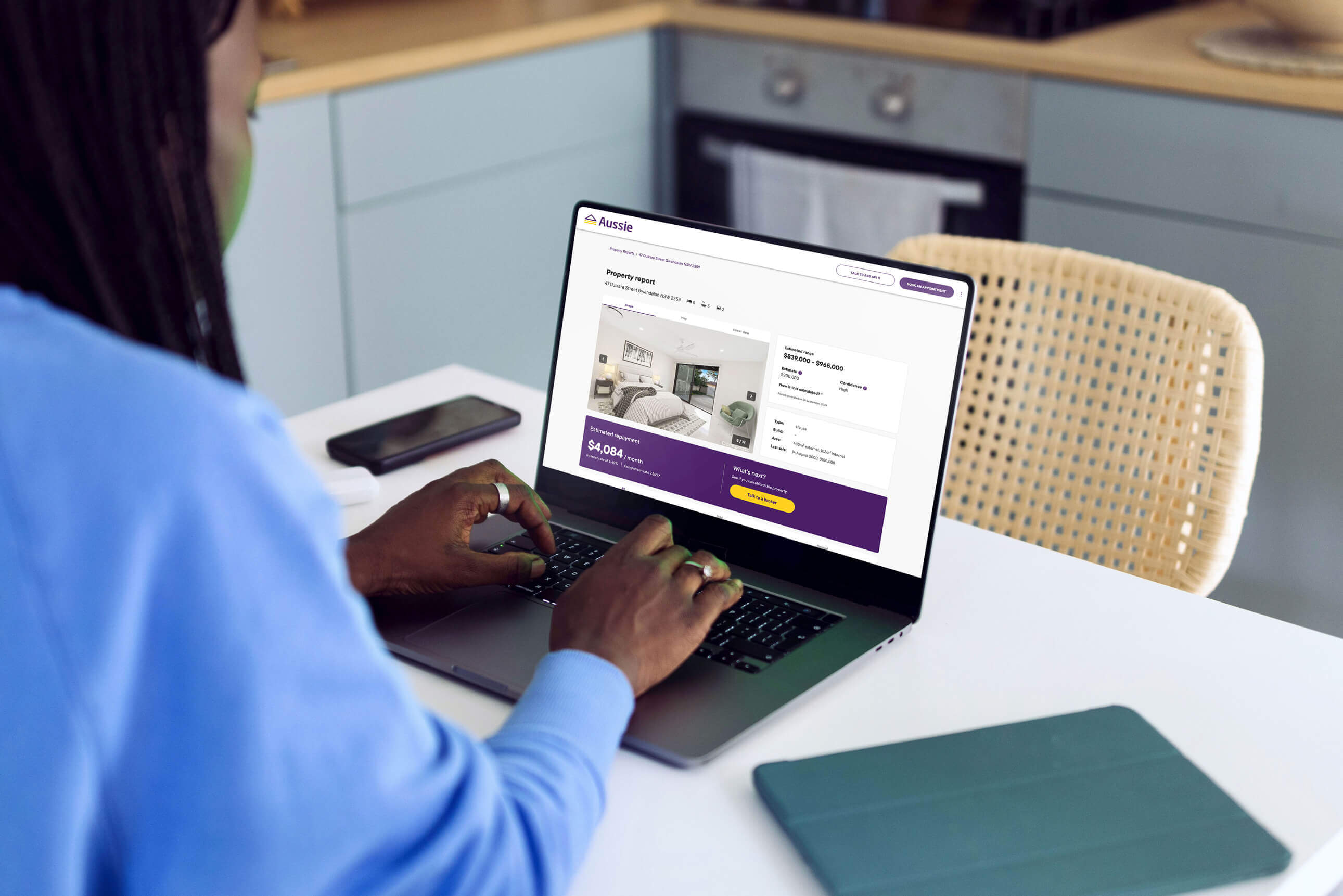
Pro tip: Use Aussie’s property search tool to compare suburbs across NSW, explore property values and access a free property report before you buy. An Aussie Broker can also help you understand how buying in different locations could affect your borrowing capacity and home loan options.
Want to know where first-home buyers are buying? Read our guide to where first-home buyers are buying and why for the latest market trends, popular suburbs and the factors driving demand.
Ready to explore your options in NSW or the ACT?
Buying your first home on a median income may still be achievable, even in higher-priced markets such as NSW and the ACT. While saving a deposit is an important milestone, it's only one part of the home-buying journey. Your borrowing capacity, the type of property you choose, where you buy and whether you're eligible for government support can all influence when you're able to purchase.
Understanding your options before you start searching can help you make informed decisions and avoid saving for longer than necessary. Whether you're considering a low-deposit home loan, exploring government initiatives or comparing properties across Sydney, Canberra or regional NSW, having a clear plan can make the process more manageable.
An Aussie Broker can explain your borrowing position, compare home loan options, and help you understand which government schemes you may be eligible for based on your circumstances.