
The RBA increased the cash rate to 3.85% in February 2026, after three cuts in 2025.
Major banks expect rates to remain data-dependent, with timing of any changes uncertain.
Borrowers can plan different scenarios by reviewing rates, repayments, and loan structure.
Comparing lenders may help borrowers stay flexible, regardless of what the RBA does next.
Interest rates in Australia are always a hot topic, particularly as borrowers search for interest rate predictions for 2026 and clarity on where the Reserve Bank of Australia may head next.
In a move that shaped economic expectations heading into 2026, the Reserve Bank of Australia (RBA) increased the official cash rate to 3.85% at its February 2026 meeting, following three cuts in 2025.
This rate decision reflects the Bank’s response to inflation remaining above its target band, and while it doesn’t pre-empt future decisions, it changes the context for borrowers and buyers in 2026.
What could happen next with interest rates in 2026?
After a period of rate cuts in 2025, the RBA increased the cash rate again in February 2026 as inflation remained above its 2-3% target band.
The Bank has said future decisions will be guided by incoming data and its evolving assessment of risks, rather than a predetermined path.
In recent statements, the RBA has emphasised that policy decisions will remain data-dependent, with the Board focused on ensuring inflation moves sustainably back to target before considering any future changes.
Views among major banks and economists remain mixed. Some expect rates to remain restrictive for longer if inflation proves sticky, while others see scope for easing later in 2026 if inflation returns sustainably to the RBA’s 2-3% target band.
This uncertainty is why searches for projected interest rates in Australia and mortgage rate predictions for 2026 have increased, as borrowers look for guidance rather than guarantees.
A look at how RBA interest rates have moved over time
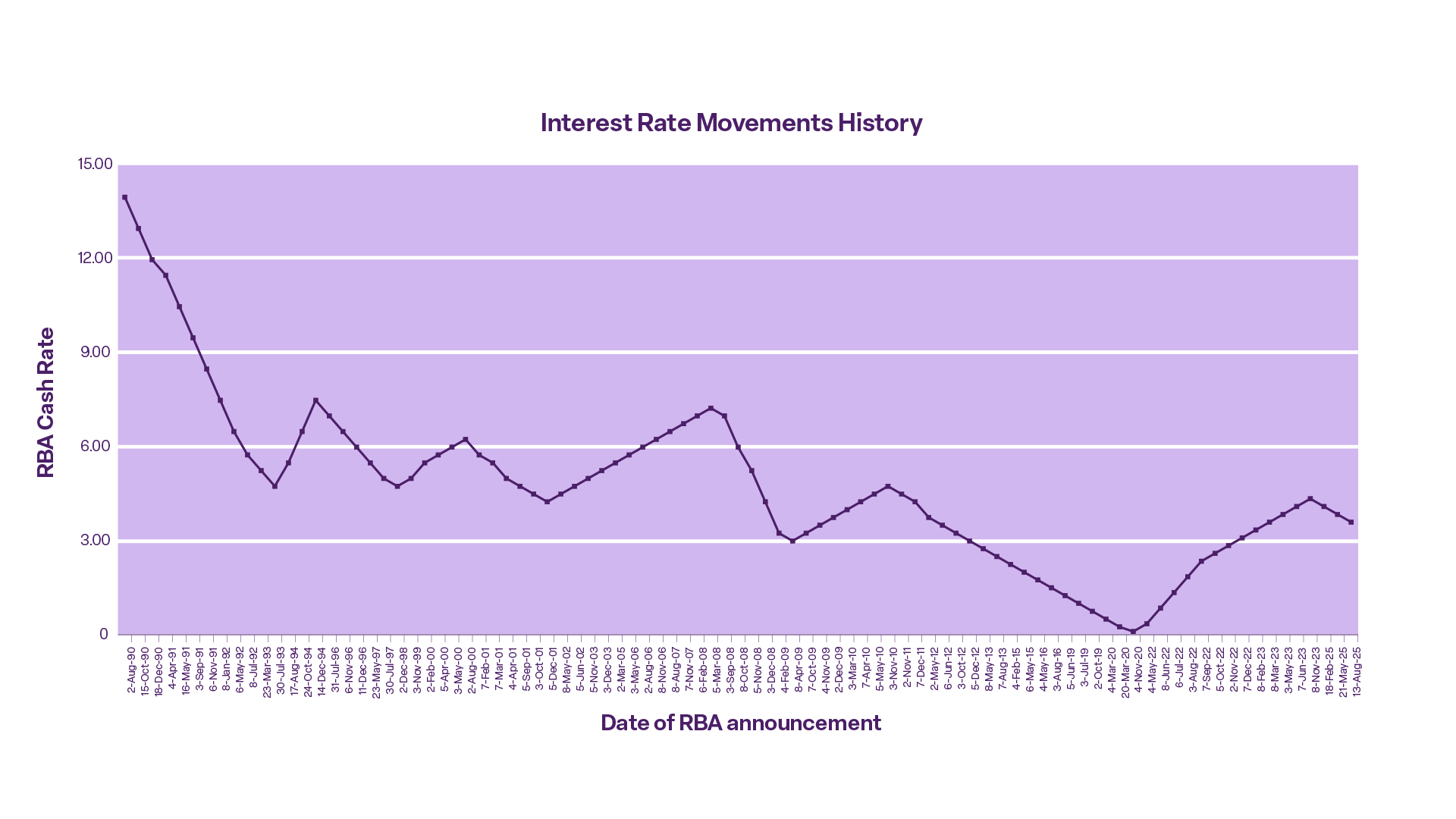
While short-term movements often dominate headlines, the RBA cash rate has changed many times over the past few decades in response to inflation, economic growth and global conditions.
Looking at how interest rates have moved historically can help put current settings into context.
How major banks are viewing the outlook
Major banks have also highlighted the uncertainty around the interest rate outlook, emphasising the role of inflation and broader economic conditions in shaping future decisions.
Westpac, for example, has noted that the path ahead will depend on how inflation evolves and whether economic conditions soften enough to justify easing later in the cycle.
Commonwealth Bank economists have similarly pointed to inflation dynamics and labour market conditions as key factors influencing future RBA decisions.
While no one has a crystal ball, economists and banks generally agree that the path for interest rates will depend on how inflation, wages and broader economic conditions evolve over time.
Possible rate paths and what they could mean
Scenario | What this could look like | What borrowers may want to consider |
|---|---|---|
Rates stay around current levels | The cash rate remains restrictive while the RBA waits for inflation to return sustainably to target. | Reviewing repayments, buffers, and loan structure to manage higher borrowing costs. |
Limited easing later in 2026 | If inflation slows and economic conditions soften, the RBA may consider easing later in the year. | Planning ahead and understanding how changes could affect repayments or borrowing power. |
Rates stay higher for longer | Inflation proves sticky or global conditions remain uncertain, keeping rates elevated. | Focusing on affordability, cash flow, and long-term flexibility rather than timing the market. |
Note: These scenarios are illustrative only.
Rather than setting a fixed path for interest rates, the RBA has said future decisions will be guided by incoming data, including inflation, wages, and broader economic conditions.
Views differ on the timing of any future moves, reinforcing the RBA’s position that decisions will remain data-dependent.
Scenario planning: What should buyers, owners, and investors do?
"While the goal posts are being moved, buyers can do so many things to take more control and avoid waiting longer than they need to while the market moves," says Alya Manji, an Aussie Broker.
Scenario 1: Rates stay around current levels in 2026
What happens: | Interest rates remain around current levels through much of 2026. Property demand may stabilise as buyers and sellers adjust to higher borrowing costs. |
Smart move: | Consider whether a fixed, variable, or split loan structure suits your situation. If you’re close to buying, speaking with a broker early can help you understand your borrowing power and options in the current rate environment. |
Scenario 2: Limited easing later in 2026
What happens: | If inflation continues to ease and economic conditions soften, the RBA may consider easing later in 2026. Buyer activity may pick up gradually, rather than all at once. |
Smart move: | Use tools like Aussie's Borrowing Power Calculator and Live Equity Tracker to model different scenarios. Reviewing your options early can help you understand how changes in rates could affect your loan. |
Scenario 3: Rates stay higher for longer
What happens: | The RBA keeps rates restrictive if inflation remains above target, or global conditions remain uncertain. |
Smart move: | Waiting for the “right time” could cost more than you think. Consider whether buying now could still work for your long-term goals. Focus on affordability, buffers, and building equity gradually. |
The cost of waiting and why timing the market can backfire
According to Aussie internal research, waiting for rates to move before buying could cost Australians billions in lost equity and rising home prices.
“Many first home buyers, including mum and dad investors we speak to, become fixated on holding out for the right price or waiting for more cuts. When in reality, buying earlier has often led to better outcomes over the past 25 years,” says Ms Manji.
Waiting for the right rate, time or house can cost first-home buyers as rising property prices outpace potential savings from changes in interest rates.
The data showed that the average ‘Waiting Tax’ nationally is estimated to be around $77,000 over the life of a loan.
What are your options right now?
You don’t have to wait for the market to change. Here’s what you can do today to take more control:
If you're looking to buy:
Use Aussie's Borrowing Power Calculator to see what you can afford.
Explore low deposit options, including guarantor loans and LMI-backed loans.
Get a free^ appointment with an Aussie Broker to understand your full buying power.
If you own a home:
Check your home’s value with a free Aussie Property Report.
Use the Aussie App to explore your equity position.
Review how recent rate changes could affect your repayments, and whether your current loan is still the right fit.
If you're investing:
Talk to an Aussie broker about unlocking equity to fund your next purchase.
Use property tools to assess rental yields, capital growth forecasts, and vacancy trends.
Consider buying before price growth outpaces the potential benefits of future rate changes.
You might also be interested in: How to buy your first home with 5 percent deposit
What a 0.25% rate rise could mean for your repayments
If the February rate rise is passed on in full, some homeowners may see their monthly repayments increase.
The example below shows how a 0.25% rise could affect repayments across different loan sizes.
Loan size | Estimated monthly increase | Estimated monthly repayment |
|---|---|---|
$400,000 | +$64 | $2,437 |
$600,000 | +$97 | $3,655 |
$700,000 | +$113 | $4,265 |
$800,000 | +$129 | $4,874 |
$1,000,000 | +$161 | $6,092 |
For homeowners, understanding how changes like this affect your repayments can help you plan, whether that’s adjusting your budget, reviewing your loan structure, or comparing options across lenders.
A quick chat with an Aussie Broker can give you clarity on your options and confidence in your next steps. Whether you're buying, refinancing, or investing, we’re here to help you take control.